
Posts

June Typos

Whew!  That’s usually the first word that pops into my head when I’ve finished writing something, but finished is probably not the right word after the first draft.  Although I’m far from an accomplished writer, I admire and respect the effort and time that goes into the art of writing, which is why writers should focus on the art and hire a proofreader for the final draft.  With proofreading in mind, I’ve been keeping my eyes open the last few weeks for examples of typos or grammatical errors to share with you. 
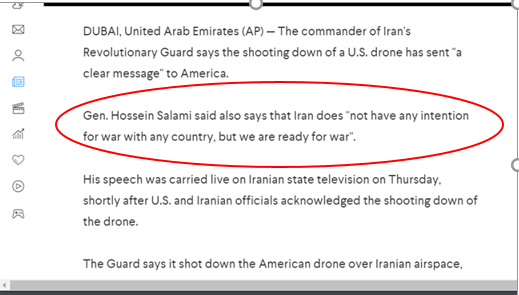
If I were proofreading this article for the author, I would ask if he or she intended to use said or says in the second paragraph because they are the past and present tense of the same verb in the same sentence.  Reading through the article, I would guess that the author intended to remain consistent and use says as that tense appears in the other paragraphs.

This paragraph also has another issue, which is the period placed outside the quotation marks.  According to Grammar Girl, a period is always inside the quotation marks, at least in the United States.  Interestingly, British English have different rules, and Grammar Girl explains that further in the above link.
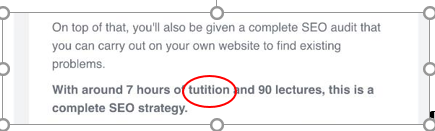
What is tutition?  I noticed that word in the last sentence from the e-mail above.  Since I don’t know everything techy, I did a Google search and found this word in several articles mixed in with the word tuition.  The articles were mainly about the cost of school tuition, so I think it’s safe to say that tutition is not a techy word and that the word tuition is misspelled quite frequently.  The second definition of tuition in the Merriam Webster Dictionary is “the act or profession of teaching: INSTRUCTION ,” and perhaps the author could just correct the spelling to convey his meaning.

I stumbled on this article during an evening of Pinterest searching.  I can’t recall what I was searching for exactly when I noticed a typo in the first sentence of this paragraph, which should read “the country club homes, waterfront, etc.”  The author had transposed two letters in the adverb etc. and had written ect. instead. The next sentence starts with “Specialize in is” and I think this might be an autocorrect issue.  Starting the sentence with the word specializing would make more sense.  There’s also a period missing at the end of the sentence.

Some of these errors would have been corrected by simply running spellcheck unless the misspelled word had been added inadvertently to the software’s dictionary, but relying on spellcheck alone isn’t always a good plan.  Hiring someone to be a fresh set of eyes to read through your writing methodically is the best way to help present your writing in a clear and grammatically correct manner.  If you’d like to discuss your proofreading needs, please contact me at sbj@efficient-essistant.com or call me at 234.855.2356.

Spending Time or Money

There are many things to take into consideration when deciding whether or not to hire a Virtual Assistant (VA), but it comes down to whether you want to spend time or money.  For example, my husband and I recently purchased a 1940 Cape Cod home.  Older homes have so much character but they, more than likely, have survived multiple homeowners with different ideas on maintaining a home. 

These different ideas are most obvious in our house by simply looking up at our ceilings.  Every ceiling has a different texture and most not very good ones.  Since we spend the majority of our time in the family room, that’s where we decided to start.  The time expended and physical pain – hello chiropractor – made me question if we would be doing it again.  Which gave me an idea about deciding when to spend time or when to spend money to get something you want. 

To start, you need to decide how much your time is worth and use it consistently throughout.  You can’t value your time at $10 an hour and then change it to $50 an hour when you’re thinking of calling a landscaper because you hate raking leaves.  If you work an hourly job making $10.00 an hour, then use that amount.  If you’re a full-time salary paid employee, then divide your yearly gross salary by 2,080 hours.  This amount will be how much your time is worth for your home job too.  To keep things simple, we’ll use $10.00 an hour from my ceiling example:

            Time Spent = 20 hours
                    x
            Hourly Rate = $10.00
            Total                 $200.00
                    +
            Materials         $45.00
                    +
            Chiropractor   $80.00
Total               $325.00    

We recently received an estimate to scrape and skim coat the other ceilings, and it worked out to be $3.17 per square foot, which includes both labor and materials.  Since the family room is 242 square foot, it would have cost $767.00 to have a contractor fix it.  Even with the much-needed visits to the chiropractor, we still saved $442 by doing it ourselves. 

Although this is a home improvement example, it perfectly illustrates when to spend your time and when to spend money.  This same exercise can be applied when a business is considering hiring a VA.  More than likely, the math will be much simpler.  If a business owner values his or her time at $50.00 per hour and a VA charges $20.00 an hour, the business owner would save money and time by hiring a VA.  The business owner can then use the time saved to do something that makes the business money.  Check out my List of Services to see what I can do to save you time and money.

How a Virtual Assistant Can Save a Company Money

Welcome to Efficient E-ssistant!  This is my first blog post for my new Virtual Assistant business, and I’m excited that you’ve found my website and are reading this post.  If you’d like to learn a bit more about me, you can do that on my “About Me” page here.  Before I explain how hiring a Virtual Assistant can save a company money, I’d like to define Virtual Assistant (VA).  Investopedia.com defines a Virtual Assistant “. . . as an independent contractor who provides administrative services to clients while operating outside of the client’s office.”  There are several reasons why a company might decide to hire a VA.  My personal experience is that it will save a business employer related payroll expenses, it can often be less expensive than using a temp agency, and it allows a company to only pay for hours of actual productivity.

When a business hires a VA, it will be doing so as a contractor, which means that the VA is not on the company payroll.  By not having to include a VA on the payroll, the company will not be responsible for taxes such as Social Security, Medicare, federal and state unemployment, and any applicable local taxes for employers.  Companies also won’t have to include a VA’s pay when calculating their workers’ compensation.  Needless to say, all of this can add up to substantial savings.

If a company needs to hire someone temporarily, a VA could be more cost effective than hiring a temporary worker through an agency.  While using a temp agency might seem like a good option, their fees can be significant.  When a business hires a temporary worker through an agency, it pays the agency who then pays the temporary worker.  If a company is paying an agency $20.00 an hour, the agency uses a portion of this $20.00 for the temp’s payroll taxes and keeps part of this hourly rate as their fee.  The agency fees vary from company to company, but the bottom line is that you’re paying the agency for every hour their temporary employee is at your place of business, and you’re still paying payroll taxes. 

Another way a company would save money by hiring a VA is by considering actual productivity.  I have worked in various office settings for more than three decades and know from first-hand experience that a multitude of events can interfere with an employee’s productivity.  I’m not talking about an employee that spends more time at the water cooler than at his or her desk.  I’m referring to the printer that needs to be unjammed or an unexpected and very talkative salesperson who isn’t taking “no thank you” as an answer.  Of course, these things are part of the job, but it’s not productive time.  When a business hires a VA, it is only paying for productive time.  I use a program called Toggl, so if my printer gets jammed while I’m working on a company’s project, a quick click of the mouse stops the timer while I’m fixing the printer.  The company doesn’t pay for this time because the jammed printer is my issue, not theirs.

I hope this post has helped encourage business owners to consider hiring a Virtual Assistant.  From employer payroll tax savings to only paying for actual productivity, a VA can become an essential part of a successful business.  Click here to view my List of Services page to see how I can help you and your company.